

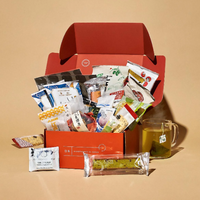


Bokksu's October 2026 Snack Box Koyo Downstream: Japanese Autumn Snacks

Open the October 2026 Bokksu Snack Box and the palette has shifted overnight. Where September was all charcoal and sumi black, October arrives in maple red, persimmon orange, and the deep brown of roasted tea. This month's theme, Koyo Downstream, follows koyo (紅葉, autumn leaves) as they drift down Japan's rivers, gathering a curated selection of Japanese autumn snacks from twelve prefectures: a mandarin manju from the slopes of an active volcano, a maple-named senbei (rice cracker) from Saitama, island chili crackers from Okinawa's Miyako Island, and a hojicha wrapped in a maple-leaf print from Kyoto.
This guide is for snack enthusiasts and anyone interested in Japanese autumn flavors. Discovering these snacks offers a delicious way to experience Japan’s seasonal traditions. By exploring Japanese autumn snacks, you can savor the unique tastes and stories that define this beautiful time of year.
In this introduction to Bokksu's October 2026 box, we look at the season that inspired it, the poem and the river that shaped the theme, the makers behind each snack, and how a single drifting leaf became one of Japan's most enduring images of autumn.
What Is Koyo? Japan's Season of Turning Leaves
Koyo (紅葉) is the Japanese word for autumn leaves changing color, and momijigari (紅葉狩り, "autumn leaf hunting") is the custom of going out to see them. The same characters can also be read momiji, which usually refers specifically to the Japanese maple.
The tradition reaches back to the Heian period (794–1185), when aristocrats in Kyoto made excursions into the hills to compose poetry beneath the maples. The Tale of Genji, written in the early eleventh century, even includes a chapter titled Momiji no Ga, the Autumn Excursion, built around a dance performed under the turning trees.
The word "hunting" is often explained as a holdover from that era: rather than chasing game, courtiers went out to hunt for the most beautiful leaves.
Today koyo is tracked with near-scientific enthusiasm. The koyo zensen (autumn color front) begins in the mountains of Hokkaido in mid to late September and works its way south and downhill over the following two months, reaching Kyushu around late November and early December.
Autumn leaves even show up on the plate. In Minoh, just outside Osaka, maple leaves are preserved in salt for about a year, then battered and fried into momiji tempura, a crunchy, lightly sweet snack sold along the path to Minoh Falls.

Maple Leaves on the Water: The Poem Behind Koyo Downstream
The image at the heart of this month's theme, red leaves carried along by moving water, is one of the oldest in Japanese art. Its most famous expression is a waka (31-syllable poem) by the Heian poet Ariwara no Narihira, included in the Kokinshu anthology of 905 and later in the Hyakunin Isshu (One Hundred Poets, One Poem Each):
Chihayaburu / kamiyo mo kikazu / Tatsutagawa / karakurenai ni / mizu kukuru to wa
Roughly: "Unheard of even in the age of the gods: the Tatsuta River, its waters tie-dyed in deepest crimson." Narihira imagines the maple leaves floating downstream so thickly that the river itself looks dyed, like a length of kimono silk.
The Tatsuta River runs through Nara Prefecture, and the poem made it so synonymous with autumn that tatsutagawa became the name of a design motif: maple leaves scattered over flowing water. You will find it on kimono, lacquerware and ceramics, and in the seasonal namagashi (fresh sweets) that confectioners shape each October, a tradition we explore in our guide to wagashi. Fittingly, Nara is also home to two of this month's sweets.
Downstream Through Kyoto: The Hozugawa River Journey
If the Tatsuta River is koyo's poem, the Hozugawa is its journey. The Hozugawa Kudari (保津川下り, "down the Hozu River") is a two-hour, 16-kilometer boat ride from Kameoka to Arashiyama on Kyoto's western edge, steered by a three-person crew with bamboo poles and oars through a gorge that turns red and gold in late autumn.
The river was a working route long before it was a sightseeing one. For centuries, timber from the forested Tanba highlands was floated downstream to build landmarks such as Tenryu-ji Temple and Osaka Castle. In 1606, a Kyoto merchant named Suminokura Ryoi cleared the boulders blocking the channel so that boats could carry rice, firewood and charcoal down to the capital. Railways and trucks eventually made the cargo trade obsolete, and the flat-bottomed boats were reborn as a way to watch the seasons pass. On an autumn run, a boatman might hook a floating maple leaf with his pole and pass it back to the passengers, a small gesture that sums up this month's theme: autumn arriving one leaf at a time, carried by the current.

Meet Chidori Manju Sohonpo, This Month's Featured Maker
Chidori Manju Sohonpo, the Fukuoka confectioner behind this month's Tirolian Ureshino Tea, traces its heritage to 1630 and to Saga Prefecture, where the Nagasaki Kaido highway ran. That road was later nicknamed the Sugar Road for the sugar and Nanban (Portuguese-influenced) confectionery traditions that traveled along it from the port of Nagasaki into the rest of Japan.
Its best-known creation came much later. In 1962, the company launched Tirolian, a crisp rolled cookie based on a traditional recipe from the Tyrol region of the Austrian Alps, made with plenty of milk and butter and filled with smooth cream. A memorable television jingle carried it well beyond Kyushu, and today it is one of Fukuoka's defining omiyage (souvenir sweets).
This month's Tirolian Ureshino Tea brings the story full circle. Ureshino tea is grown in Saga, the same prefecture where the company's roots lie, and its mellow green tea flavor fills the cream inside the delicate rolled cookie. It is a Western-style sweet with deep Kyushu roots, exactly the kind of cross-cultural confection the Sugar Road was built on.
The Sweet Side of Koyo Downstream
October's sweets move through the season the way the koyo front does, from citrus-bright to roasted and caramelized.
Sekaiichi Komikan Manju, by Kagoshima Yutaka
Sakurajima, the active volcano across the bay from Kagoshima City, grows a citrus found almost nowhere else: the Sakurajima komikan, celebrated as the world's smallest mandarin orange. Kagoshima Yutaka folds that bright, fragrant citrus into a bite-sized manju (a soft bun with a sweet filling), a taste of Kyushu's southern tip at the very start of the season.
Financier Sandwich: Salted Caramel, by Igetado
Igetado returns from Aichi Prefecture after last month's black sugar financier, this time in sandwich form, with a texture that moves from moist and buttery to satisfyingly crunchy around a salted caramel center. Caramel is the color of late koyo, when the reds fade to amber on the forest floor.
Black Sesame Bites: Maple, by Okinawa Pioneer Foods
From Okinawa, these crunchy bites combine black sesame with kokuto (Okinawan black sugar) and maple, a nod to the tree that defines the month. The sesame brings roasted depth, the black sugar adds mineral warmth, and the maple rounds everything out with a gentle, woodsy sweetness.
Koi Matcha Feuillantine Crunch, by Realize Planning
Koi means "rich" or "deep," and this Osaka-made bite leans all the way into it: intense matcha chocolate studded with feuillantine, thin crisp flakes of baked crepe, for a crackling texture and a lingering green tea bitterness. It is the evergreen in a box full of red.
Kyoto Matcha Waffle Sandwich & Osaka Caramel Almond Crush Cookie
Alongside these sit two souvenir favorites from Maeda Seika in Nara, last month's featured maker: the Kyoto Matcha Waffle Sandwich and the Osaka Caramel Almond Crush Cookie, crunchy with caramel and crushed almonds.
Baked Cookie: Yuzu, by Kuritaen
The Baked Cookie: Yuzu from the Ryotei Takigawa line, produced by Kuritaen in Kanagawa, brings yuzu's bright Japanese citrus to a buttery baked cookie.
Mire Biscuit Crunch Chocolate Matcha, by Waraiya
And the Mire Biscuit Crunch Chocolate Matcha from Waraiya in Kochi Prefecture coats pieces of the Mire biscuit, a small, lightly salted biscuit that has been a Kochi pantry staple for generations, in matcha chocolate.

The Savory Side of Koyo Downstream
On the savory side, autumn tastes like toasted rice, sea breeze and a slow-building heat.
Momiji Senbei, by Senbei Lab
Saitama Prefecture, and the city of Soka in particular, is one of Japan's great senbei regions, with a cracker-making tradition tied to the old post town on the Nikko Kaido highway. Senbei Lab's Momiji Senbei takes its name from the Japanese maple, making it this month's most literal nod to the theme: a crisp, toasty rice cracker built for autumn snacking.
Miyako Island Shima Togarashi Senbei, by Tomiyama Shoten
Shima togarashi (island chili) is Okinawa's small, fiery chili pepper, the same one steeped in awamori to make the table condiment koregusu. On Miyako Island, roughly 300 kilometers southwest of Okinawa's main island, Tomiyama Shoten works it into thin, shatteringly crisp senbei with a heat that builds slowly, as bright as a maple leaf at its peak.
Iso Ebi Arare, by Ajikaru
Niigata grows some of Japan's most prized rice and is the heartland of arare (bite-sized crackers made from glutinous rice). Iso means "rocky seashore," and these arare taste like it: toasty rice puffs seasoned with shrimp and the briny aroma of the coast.
Strong Ume Zanmai, by Koikeya
Koikeya, one of Japan's pioneering potato chip makers, puts umeboshi (pickled Japanese plum) front and center. Zanmai means "indulgence" or "all in," and the flavor is exactly that: bold, puckering, salty-sour ume on a crisp chip. It is brand new, too, having only reached shelves in Japan in mid-September.

A Tea to Close the Set
October's tea is the Momiji Hojicha from Maiko no Cha Honpo in Kyoto, packaged in a maple-leaf pattern for the season. Hojicha is green tea roasted over high heat, which turns the leaves reddish brown, softens the bitterness and lowers the caffeine, leaving a toasty, almost caramel-like aroma. Hojicha is typically brewed with hotter water than most green teas, so follow the steeping directions on the pack. It is an easy partner for the Tirolian or the yuzu cookie.

Twelve Prefectures in One Box
Koyo Downstream travels through twelve prefectures:
-
Niigata
-
Saitama
-
Tokyo
-
Kanagawa
-
Aichi
-
Kyoto
-
Nara
-
Osaka
-
Kochi
-
Fukuoka
-
Kagoshima
-
Okinawa
Read from north to south, the list follows the koyo front itself. The arare come from Niigata's rice country, where the leaves turn early. The maple senbei and ume chips come from the Kanto plain around Tokyo. The matcha and hojicha come from Kyoto, the historic heart of momijigari. Then the route keeps drifting south, to Kochi on Shikoku, to Fukuoka and the Sugar Road, to the volcano island of Sakurajima, and finally to Miyako Island in Okinawa, where autumn is marked less by maples than by the last of the summer heat.
Revisiting Our Past Themes
Koyo Downstream picks up right where last month's Ink & Stone left off, moving from the monochrome of sumi-e into full autumn color. It also sits in good company with past autumn boxes. October's Moonlight Market gathered rare night-time finds from across Japan, and Autumn Hues Awaken followed the country into its most celebrated season. If this month has you thinking about moon viewing as well as leaf viewing, our guide to tsukimi traditions around Japan is a natural next read.
Frequently Asked Questions
-
What is the October 2026 Bokksu Snack Box theme?
-
The October 2026 theme is Koyo Downstream, Volume #90. It is inspired by koyo, Japan's autumn leaves, and the classical image of maple leaves drifting down rivers such as the Tatsuta in Nara and the Hozugawa in Kyoto. The box features thirteen snacks and a seasonal momiji hojicha from twelve prefectures.
-
-
What does koyo mean in Japanese?
-
Koyo (紅葉) means autumn leaves or the changing of leaf color, and the same characters can be read momiji, meaning Japanese maple. The custom of going out to view them is called momijigari, which dates back to the Heian period (794–1185).
-
-
What is the Tatsuta River poem?
-
It is a waka by the Heian poet Ariwara no Narihira, collected in the Kokinshu (905) and the Hyakunin Isshu. The poem describes the Tatsuta River in Nara so full of floating maple leaves that its water looks tie-dyed crimson, and it inspired the tatsutagawa design motif of maple leaves on flowing water.
-
-
What is the Hozugawa River boat ride?
-
The Hozugawa Kudari is a two-hour, 16-kilometer traditional boat ride down the Hozu River from Kameoka to Arashiyama in Kyoto Prefecture. The waterway was opened for boat traffic in 1606 by the merchant Suminokura Ryoi, and today it is one of Kyoto's most popular ways to see autumn leaves.
-
-
How many prefectures are represented in the October 2026 box?
-
Twelve: Niigata, Saitama, Tokyo, Kanagawa, Aichi, Kyoto, Nara, Osaka, Kochi, Fukuoka, Kagoshima and Okinawa.
-
-
Which maker is featured this month?
-
Chidori Manju Sohonpo of Fukuoka, a confectioner whose heritage traces to 1630, is featured with its Tirolian Ureshino Tea, a crisp rolled cookie first launched in 1962 and filled here with a cream flavored with Ureshino green tea from Saga Prefecture.
-
Discover Japan One Snack at a Time with Japanese Snack Packages
Koyo is a reminder that the most beautiful part of a season is often the part already moving on. Leaves turn, drift and land somewhere downstream, and Japan has spent more than a thousand years learning to notice them along the way. This month's makers each capture that moment differently, from Kagoshima Yutaka's volcanic-island citrus to Tomiyama Shoten's island chili senbei to Chidori Manju Sohonpo's Ureshino tea Tirolian, a recipe that traveled from the Alps to the old Sugar Road of Kyushu.
Every box includes a Culture Guide with the stories behind each maker, so the snacks arrive with their context intact. If you would like Koyo Downstream to land on your doorstep, subscribe to the Bokksu Snack Box and follow the season downstream, one snack at a time.

-
Trending Posts

-


Author Bio
More from the blog
View all


