

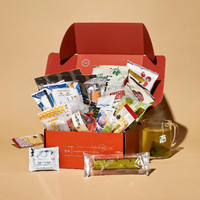


Bokksu's November 2026 Snack Box First Snow on Fuji: Japanese Mt. Fuji Snacks

Open the November 2026 Bokksu Snack Box and the season has turned again. October's maple reds have drifted downstream, and in their place stands Japan's most famous silhouette, Mt. Fuji, waiting for its first white cap of the year. This month's theme, First Snow on Fuji (富士の初雪, Fuji no Hatsuyuki), celebrates the moment Japan watches for every autumn: the day the summit of its tallest mountain turns white and the country quietly agrees that winter is on its way.
The box gathers a curated selection of Japanese winter snacks from eleven prefectures: Fuji-shaped biscuits and milk-and-white chocolate crunch from a Shizuoka confectioner at the mountain's foot, sugar-glittered senbei, a Fuji-shaped sweet potato manju, a strawberry sablé from Aomori that is debuting in this box before anywhere else, and a rare Japanese black tea grown in the hills below Hakone. In this guide, we look at the tradition behind the theme, the art that made Fuji an icon, the makers behind each snack, and why this year's first snow is being recorded in a way Japan has never used before.
What Is Hatsukansetsu? Japan's Watch for Fuji's First Snow
Hatsukansetsu (初冠雪) means "first snowcap," the first time in a season that a mountain's summit is seen dusted in white. Japan tracks it for dozens of peaks, but none draws as much attention as Fuji, whose first snowcap is treated as a small national news event each autumn.
For 132 years, the call was made by eye. Since 1894, staff at the Kofu Local Meteorological Office in Yamanashi Prefecture judged Fuji's first snowcap by looking at the mountain from Kofu, and the long-term average date settled at October 2. The record has swung widely: the earliest cap arrived on August 9, 2008, while in 2024 the summit stayed bare until November 7, the latest since records began. In 2025, the first snow came on October 23, three weeks behind the average.
This season marks a historic change. Starting in autumn 2026, the Japan Meteorological Agency no longer relies on an observer looking across the Kofu Basin. It now determines Fuji's first snowcap from analyzed snow-depth data, drawn from AMeDAS weather stations, radar and the Himawari satellite, which can read the summit even at night or under cloud. Under the new system, the agency announced Fuji's first snowcap of the season on October 30, 2026. Because the method has changed, that date cannot be compared directly with the old average, so this year begins a new record of its own.

Red Fuji, White Fuji: How Mt. Fuji Became Japan's Icon
At 3,776 meters, Fuji is Japan's highest mountain, straddling Shizuoka and Yamanashi prefectures. For centuries it has been a place of pilgrimage, and in 2013 it was inscribed as a UNESCO World Heritage Site under the title "Fujisan, sacred place and source of artistic inspiration," a recognition of its role in art as much as in religion.
No artist shaped that image more than Katsushika Hokusai. His series Thirty-six Views of Mount Fuji, published around 1830 to 1832, includes "Fine Wind, Clear Morning," better known as Red Fuji, which shows the mountain glowing rust-red under a morning sky. That red color, called akafuji, is a real phenomenon. In late summer and early autumn, before the snow arrives, the rising sun can turn the bare volcanic slopes a deep reddish brown. Once the snowcap settles in for winter, the dawn light paints it a softer pink instead, a sight called benifuji.
In other words, the first snow is the hinge between two of Fuji's most beloved faces, the red mountain of summer's end and the white-capped mountain of winter. It is also why this month's tea carries the name Akafuji, a nod to the season the snow is about to close.
Ritto and the White Peak: Watching Winter Arrive
Japan's traditional calendar divides the year into twenty-four small seasons called sekki, and ritto (立冬), the beginning of winter, falls around November 7. It usually arrives while the maples are still red, so for a few weeks the country lives in two seasons at once: autumn color in the valleys, fresh snow on the summit. Households mark the turn quietly, with heavier bedding, the kotatsu (a heated low table draped with a quilt) pulled back out, and the first hot drinks of the season.
The weeks after the first snow are also when Fuji is most photographed. Dry winter air sharpens the view, and on still mornings Lake Kawaguchi reflects the whole white peak. The Chureito Pagoda in Fujiyoshida frames the summit above its five vermilion tiers. For most people in Japan, though, the first white Fuji of the year appears the ordinary way, through a train window on the Tokaido Shinkansen, flashing into view between tunnels.
Meet Ragueneau Sasaki, This Month's Maker
Ragueneau Sasaki is a confectioner in Hirosaki, a castle town in Aomori Prefecture at the northern tip of Japan's main island, where winter arrives early and stays long. Its history stretches back more than 140 years. The company began in 1884 as a small mochi shop called Wagashi Sasaki, and in 1958 it opened a Western-style confectionery shop named Ragueneau.
The name comes from an unexpected source: Ragueneau, the pastry chef in the French play Cyrano de Bergerac, a baker who loved bringing joy to poets and artists through his sweets. The family chose his name for the shop to reflect that same spirit. Today Ragueneau Sasaki makes both Japanese and Western-style sweets, including local specialties built around Aomori's famous apples, and it is especially known for bringing traditional Japanese confectionery techniques into Western-style treats.
This month's Yakkoi Sable Strawberry shows exactly that skill. Yakkoi is the local word for "soft" in Aomori, and softness is the whole idea: the sablé gives way instead of snapping, with a gentle strawberry sweetness that never turns candied. The strawberry flavor is Ragueneau Sasaki's newest creation and is making its debut in this Bokksu box, so for now, this is the only place to try it.
The Sweet Side of First Snow on Fuji
November's sweets move from the comfort of a warm kitchen to the sparkle of early frost.
Spotlight Snack: Sweet Potato ZakuZaku Manju, by Meiho Shokuhin
This month's Spotlight Snack is shaped like Mt. Fuji itself. Zakuzaku is the Japanese word for a rough, crunchy sound, and it describes the manju's craggy, textured look rather than its bite: the baked shell is actually soft and moist, wrapped around a smooth filling of satsumaimo (Japanese sweet potato). Sweet potato is one of Japan's favorite autumn flavors, and this little mountain from Aichi Prefecture captures its mellow, earthy sweetness in every bite.
Mt. Fuji Biscuits and Mt. Fuji Chocolate Crunch: Milk & White, by Doi Seika
Doi Seika works out of Shizuoka, the prefecture that looks up at Fuji's southern face, and its Fuji-shaped sweets are souvenirs in the truest sense, sold at the foot of the mountain they depict. This month it contributes two Fuji treats. The Mt. Fuji Biscuits are light, buttery biscuits sandwiching white chocolate, with just enough salt to keep the toasted flavor forward. The Mt. Fuji Chocolate Crunch looks the most like the theme: milk chocolate for the mountain, white chocolate for the snow, with crisped rice running through both.
Mt. Fuji Senbei Kirazara, by Senbei Lab
Kira kira is the Japanese sound of something sparkling, and zarame is coarse sugar that stays visible as crystals instead of dissolving. Scattered across a thin senbei from Saitama, it catches the light and gives each bite a grainy crunch before the toasted rice comes through underneath, sugar settling on rice the way snow settles on the peak.
Custard Pudding Dorayaki, by Tenkei Seika
Dorayaki is two small pancakes around a filling, traditionally anko (sweet red bean paste). This one from Nagano swaps in purin, the custard pudding Japan has made its own: a soft, honey-scented sponge around a cool, vanilla-sweet custard, somewhere between a cake and a breakfast.
Mt. Fuji Cider Gummies, by North Colors
Japanese saida (cider) is not apple cider but a clear, sharply carbonated soda, and these Fuji-themed gummies from North Colors keep that fizz in chewable form: bright and slightly tart, then gone before it lingers. A light place to start the climb.
Three more sweets round out the set. Tokyo's Tohato contributes Salty Butter Cookies, where a touch of salt sharpens rich butter without tipping into savory. Kurakit Condensed Milk Cream sandwich cookies from Takara Seika in Kanagawa go crisp first and soft second, milky white straight through the middle. And the Usu-Yaki Peanut Cookies from Osaka are rolled so thin they shatter rather than crumble, more toasty than sweet.

The Savory Side of First Snow on Fuji
On the savory side, November tastes like soy sauce, roasted garlic and a little black pepper, the kind of snacks that belong next to a warm drink on a cold evening.
Fujisan Shichihenge, by Senbei Lab
Shichihenge means "seven transformations," a phrase used for something that shows a different face each time you look. Senbei Lab's rice cracker lives up to it, shifting flavor from piece to piece, just as Fuji does across a single day: pink at dawn, gray by noon, white by the time the light goes.
Jari-Sen Rice Crackers: Soy Sauce, by Mochikichi
Mochikichi bakes these in Fukuoka Prefecture, thin enough that the crunch is the entire point. Jari describes a gritty, gravelly sound, and the name is not being subtle. The soy sauce is brushed on and baked in, salty and faintly caramelized: the plainest pleasure in the box.
Mini Asparagus: Black Pepper, by Ginbis
Ginbis's asparagus stick has been a fixture of Japanese snack shelves for decades, ridged like the vegetable it is named after and tasting nothing like it. This smaller version adds black pepper to the sesame-and-wheat biscuit, leaving a slow warmth at the finish. Pepper earns its place in cold weather.
Two more savory picks complete the set. Lucky Mayo Mix Okaki from Sanshin in Chiba is a mix of okaki, the chunkier branch of the rice cracker family baked from pounded mochi, seasoned with creamy, faintly tangy mayonnaise, with shrimp and squid worked in for depth. And Koikeya's Potato Chips: Garlic toast the garlic rather than leaving it raw, so it reads warm instead of sharp, the savory anchor of the box.

A Tea to Close the Set
November's tea is the Hakone Sanroku Black Tea Akafuji from the Kanagawa Prefecture agricultural cooperative's tea center, grown in the foothills of Hakone, the hot-spring and mountain region whose ridges look out toward Fuji. Its name, Akafuji or "Red Fuji," points back to the mountain's late-summer glow. Japanese-grown black tea, known as wakocha, is far less common than Japanese green tea, and this one pairs especially well with the Custard Pudding Dorayaki. It is mild and low in tannin, so it holds its own without milk.
To brew it, pour about 200 ml (7 oz) of freshly boiled water over the tea bag and steep for 1–1.5 minutes with the cup covered. Gently shake the bag before removing it, and do not squeeze it, which can make the tea bitter. Then sit somewhere with a view of the cold outside.

Eleven Prefectures in One Box
First Snow on Fuji travels through eleven prefectures: Hokkaido, Aomori, Saitama, Chiba, Tokyo, Kanagawa, Nagano, Shizuoka, Aichi, Osaka and Fukuoka.
At its center is the mountain itself. Shizuoka, at Fuji's foot, supplies the Fuji biscuits and chocolate crunch, Kanagawa brings the Akafuji tea from the Hakone foothills, and Tokyo, Saitama and Chiba sit within sight of Fuji on a clear winter day. Aichi, farther west, contributes the Fuji-shaped sweet potato manju. From there, the box reaches north to snowy Aomori and Hokkaido, where winter arrives first, and south and west to Osaka and Fukuoka, tracing the path the season's cold air will soon take across the country.

Revisiting Our Past Themes
First Snow on Fuji completes a run of autumn boxes that followed the season from the monochrome of September's Ink and Stone to the maple reds of October's Koyo Downstream. If you enjoyed October's leaf-viewing theme, our story on momiji tempura, the deep-fried maple leaves of Minoh, is a natural companion read. And since November is when many people start thinking about year-end gifts, our guide to whether a Japanese snack subscription makes a good gift may come in handy.
Frequently Asked Questions
What is the November 2026 Bokksu Snack Box theme?
The November 2026 theme is First Snow on Fuji (富士の初雪), Volume #91. It celebrates hatsukansetsu, the first snowcap on Mt. Fuji each autumn, and features fifteen different snacks and a Hakone-grown black tea from eleven prefectures, including several Fuji-shaped treats.
When does Mt. Fuji get its first snow?
Historically, Mt. Fuji's first snowcap arrives around October 2 on average, based on observations that began in 1894. Recent years have run late: the first snowcap came on November 7 in 2024, the latest on record, and on October 23 in 2025. In 2026, under the new measurement system, the first snowcap was announced on October 30.
How is Mt. Fuji's first snow measured?
Until 2025, staff at the Kofu Local Meteorological Office declared Fuji's first snowcap by looking at the mountain from Kofu, a practice dating to 1894. From the 2026 season, the Japan Meteorological Agency uses analyzed snow-depth data instead, combining weather station, radar and satellite readings, which can detect snow on the summit even at night or under cloud.
What is Red Fuji?
Red Fuji, or akafuji, is the reddish glow on Mt. Fuji's bare slopes at sunrise in late summer and early autumn, before the snow arrives. It was famously depicted in Hokusai's print "Fine Wind, Clear Morning" from Thirty-six Views of Mount Fuji.
Which maker is featured this month?
Ragueneau Sasaki of Hirosaki, Aomori Prefecture, founded in 1884 as a mochi shop and named after the pastry chef in Cyrano de Bergerac. Its Yakkoi Sable Strawberry is a brand-new flavor debuting in this box.
What is ritto?
Ritto is the beginning of winter in Japan's traditional calendar of twenty-four seasons, falling around November 7. It is marked at home with heavier bedding, the kotatsu heated table and the first hot drinks of the season.
Discover Japan One Snack at a Time with Japanese Snack Packages
Every year, Japan waits for the moment Fuji turns white. Some years it comes early, some years it is weeks late, and this year, for the first time in more than a century, it was called not by an observer in Kofu but by data, on October 30. What has not changed is the feeling: a quiet signal that the warm months are over and the season of hot tea, cozy evenings and shared snacks has begun. This month's makers each capture a piece of that feeling, from Doi Seika's Fuji-shaped biscuits made at the mountain's foot to Ragueneau Sasaki's soft strawberry sablé from snowy Aomori, a flavor making its debut in this very box.
Every box includes a Culture Guide with the stories behind each maker, so the snacks arrive with their context intact. If you would like First Snow on Fuji to land on your doorstep, subscribe to the Bokksu Snack Box and welcome the first snow of the season, one snack at a time.

-
Trending Posts

-


Author Bio
More from the blog
View all


